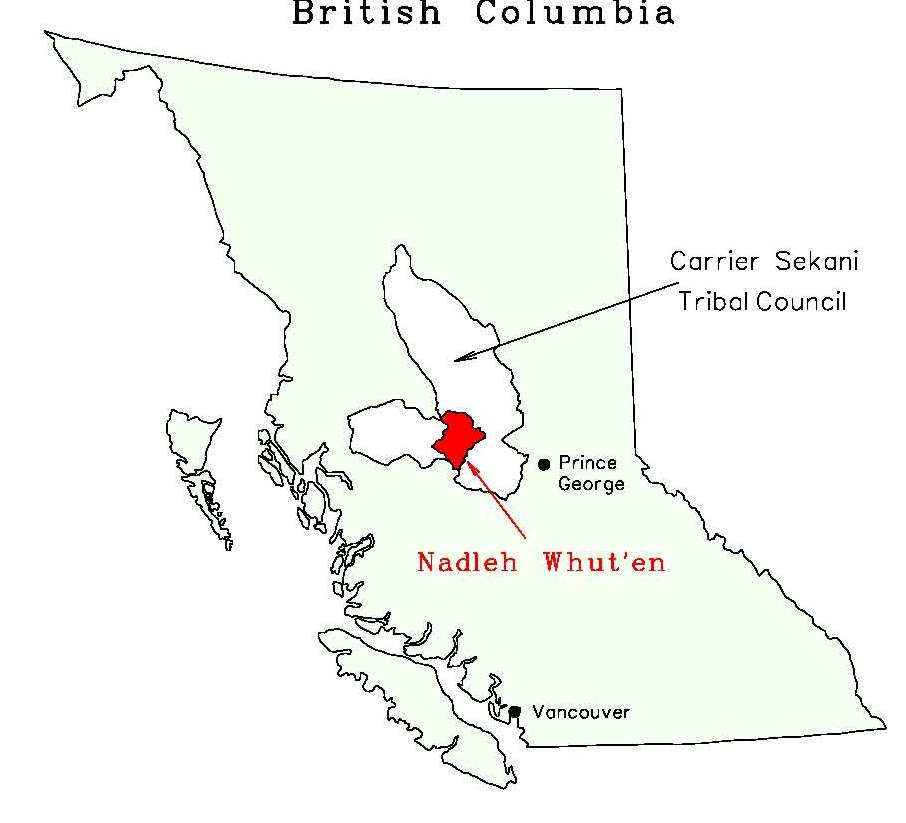
Bear About Carrier Sakani Nation
Carrier and Sekani people historically have resided in a vast territory, of over 76,000 kilometers, primarily located in North Central British Columbia. Today there are approximately 22 Indian Bands or First Nations, as recognized by the Department of Indian Affairs that identify as being Carrier or Sekani societies. The population represented by Carrier Sekani First Nations comprises over 10,000 individuals. Among the Carrier and Sekani people there are
distinct groupings which maintain geographic and linguistic
characteristics different from other groupings of Carrier people.
Current research divides Carrier into two major dialect groups within
the Athabaska language family, a Stuart-Trembleur Lake group, and a
Southern group. Within the Stuart-Trembleur Lake sub group there are six distinct Carrier linguistic dialects of the Athabaskan language family: Babine, Cheslatta, Nakazd’li, Saik’uz, Lheidli-T’enneh and Wet’suwet’en. Carrier people maintain a governance system commonly referred to as the bah’lats or potlatch. Four primary clans make up Carrier society Likh ji bu (Bear), Gilhanten (Caribou), Jihl tse yu (Frog), and Likh sta Mis yu (Beaver), each with several sub-clans. Carrier Nations are not exempt from the impacts
of colonization which have negatively impacted the lives of First
Nations people in Canada. Impacts have manifest in a number of
concerns including child apprehension, poverty, poorer health outcomes
and under-employment compared to other Canadians. In addition to community processes such as the bah’lats that are a source strength in maintaining culture and language, Carrier Sekani peoples have developed institutions such as Carrier Sekani Family Services to reassert control in areas that have been sources of attack on community values and teachings in order to assume responsibility for health, social, legal and research services for their nation. This story was from Carrier Sekani Family Service  Goose |
I am very interested finding more about my culture, it makes me feel more involved and understand more about which tribal I am involved with. I found out more about this when my grandmother told me, and this was one of the most exciting news to hear after years of wondering who my real family is and which tribe I'm with. I look forward to research more, and understand more about my culture with art, geography and history.  Cariboo Goose Story
The story below tells of the strength and unity of the goose, all of which the CSTC represents in its work for the Carrier and Sekani people. In autumn we see gees flying along in a "V" formation as they head south for the winter. You might be interested in knowing what science has discovered about why they fly that way. Scientists have discovered that, as each bird flaps its wings, it creates uplift for the bird immediately following. By flying in a "V" formation, the whole flock adds at least 71% greater flying range than if each bird flew on its own. When people share a common direction and sense of community, they can get where they are going easier and faster because they are traveling on the thrust of one another. Whenever a goose falls out of formation, it feels the drag and resistance of trying to do it alone and quickly gets into formation to take advantage of the lifting power of the bird immediately in front. If we have much sense as a goose, we will stay in formation with those who are heading the same direction as us. When the lead goose gets tired, he rotates back into the wing and another goose flies point. It pays to take turns doing hard jobs - with people or geese flying south. The geese honk from behind to encourage those up front to keep up their speed. What do we say when we honk from behind? Finally, when a goose gets sick or is wounded by hunters and falls out, two other geese fall out of formation and follow him down to help and protect him. They stay with him until he is able to fly or he dies. They then launch on their won or with another formation to catch up with the group. If we have the sense of a goose, we will stand by each other. This story was from CSTC (Carrier Sekani Tribal Council) |
|||
|
||||